
Prospect and Refuge
There might be nothing wrong with me after all

There are 27 official national landscapes in Finland, but surely the most famous and beloved of them open up from the heights of Koli in Eastern Finland. Forest stretching farther than the eye can see, broken by lakes here and there – a place where the human being may feel small and creation immense.
I have lived in this old wooden house for fifteen years. From here we have an open view over the Aurajoki river and its valley, from this hill all the way to the horizon kilometres away, and on cloudless evenings the sun sets behind the tree line, filtering as tangerine-coloured light onto the white tiled fireplace and violet orchid wallpaper in our living room.
I’m Janina from Finland, and you are reading Nest Regards,
a publication about small wonders in nature,
seen through the eyes of a middle-aged humanist
studying biology and environmental science.
This letter is about prospect and refuge.
My good friend – the same one whose child taught me something very important about little mushrooms in my previous letter – has admired our view for as long as I can remember. To be able to see far, now that is something, she says. And of course I too enjoy the sunset, and the river is a beautiful stage for swans (joutsen in Finnish and goldeneyes (telkkä) to land upon. But the openness of a landscape in itself has always felt foreign to me as a value.
A couple of springs ago, I happened to be chatting with the elderly lady next door on our shared gravel road. We marvelled at the weather and the seasonal happenings of nature, as one does. (Is there any culture in the world that does not include small talk about the weather?) The lady told me she had contacted property maintenance – or whatever the correct authority was; I know beetle taxonomy much better than human administrative structures – asking them to come and cut down the willows (paju) flourishing along the roadside so that we could see the river better and enjoy the landscape more fully. One of our national landscapes too, by the way.
The willows!
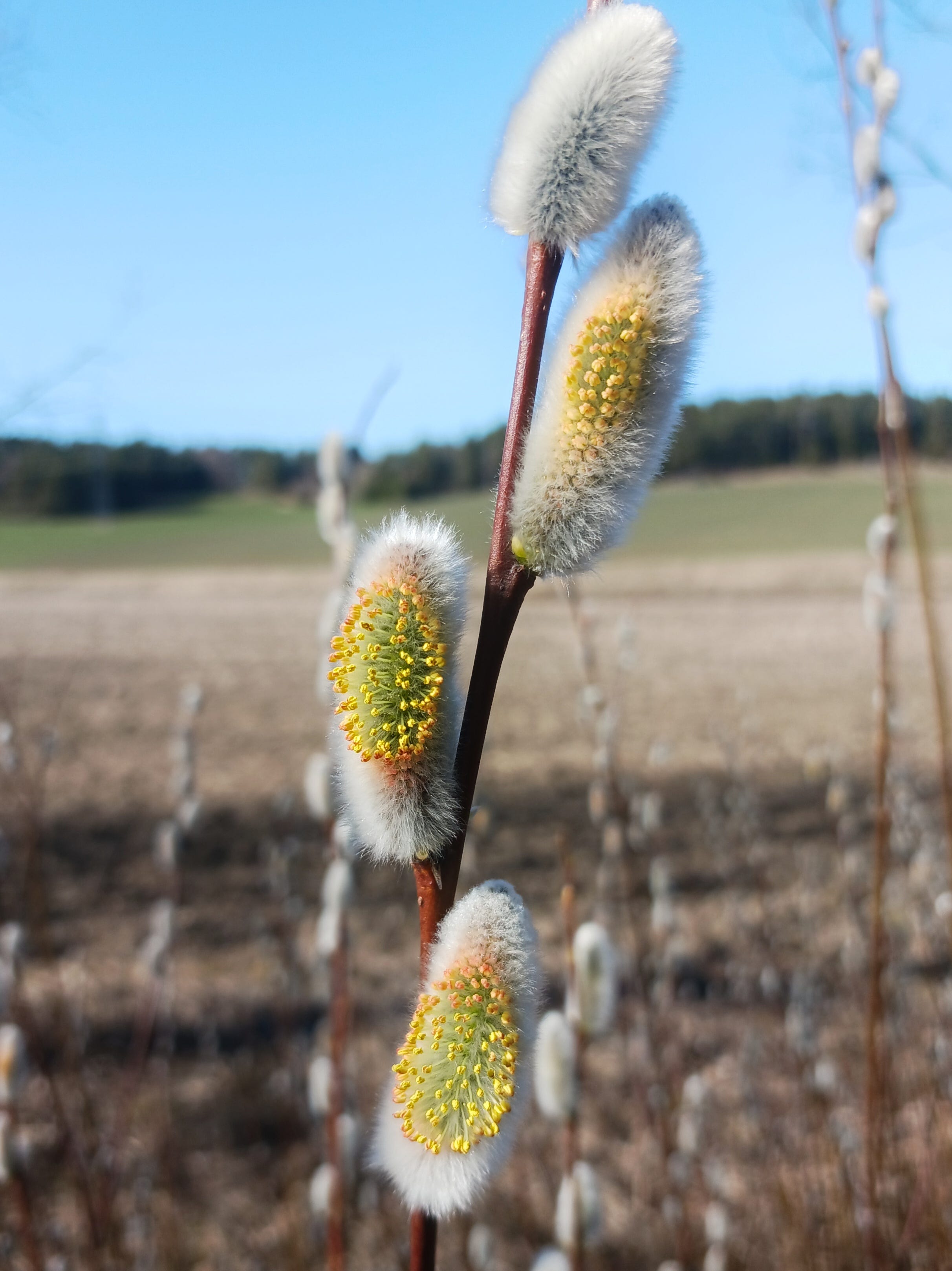
She wanted to cut down those very same willows whose flowering I wait for every spring almost holding my breath, the willows I photograph and whose blossoming – and therefore also sex lives and inner lives – I document on my social media channels with great fascination and humble respect. As early bloomers, willows are an extremely important food source for queen bumblebees (kimalainen) waking from hibernation in spring, and those queens in turn carry the responsibility of founding entire bumblebee colonies and thus, indirectly, pollinating bilberries (mustikka) and many other plants important also to humans.
Right, I said to the lady.
I am a writer far, far more than I am a speaker, let alone a debater. (Please remind me again why I thought politics of all things might suit me.) In typical writerly fashion, my expression of opinion regarding the cutting of the willows remained at “Right” – and only now, two years later, have I returned to the matter by writing about it.
I love willows. I also love beautiful landscapes. I believe one does not need to be sacrificed entirely for the other, but that both can exist side by side in this living world of ours.
The willows were cut down.
Of course they were cut down, but do not worry. Willows are thankfully such a stubborn crowd that now, a couple of springs later, the bushes are growing back more defiant and lush than ever. I can only hope that the queen bumblebees managed in the meantime to find enough food to survive and witness this new abundance. (Just last week I brought home yet another willow sapling for my garden from a garden centre – only four euros, imagine! Though it will still take a little while before I manage to turn my garden into a true refuge for pollinators suffering from all manner of landscape management practices. No worries, however – the project is well underway.)

I understand the cultural and historical value of open landscapes. I understand that for some people – perhaps most people – the most magnificent thing imaginable is a view over endless nature from a seashore or the top of a fell.
I am simply not one of them.
Truthfully, I would like to live deep within an old-growth forest, a house held tightly in the embrace of ancient trees. My landscape of the soul is a sheltered, lush forest – not the kind of tangled thicket typical of commercial forestry, but one where trees of many ages are allowed to grow at their own slow pace among their family members, where the forest floor is covered in unbroken moss carpets, perhaps a wood anemone (valkovuokko) standing here, a wood sorrel (käenkaali) over there. Forest horsetails (metsäkorte) swaying in the wind in one place, brackens (sananjalka) in another. And when night came, I, a small human being, could curl up at the foot of a spruce tree (kuusi) and let its lowest branches cover my human body just as darkness covers the body of the forest. And there I would be safe. In the deepest embrace of the forest, nothing bad can happen to me.

A couple of weeks ago I took part in a forest therapy guide training (Terveysmetsä®) course in Helsinki. According to M. Amos Clifford, founder of the Association of Nature and Forest Therapy Guides and Programs (ANFT), “The forest is the therapist, the guide opens the door.” I will surely write more about the subject later, but during the training I came across an interesting perspective:
Human beings need both refuge and prospect from a restorative environment.1
But also this:
The longing for refuge or prospect may reflect a person’s current emotional state.
In times of crisis, people tend to seek more shelter also from natural environments, whereas people who are flourishing and future-oriented tend to value openness and far-reaching views more highly in nature.
This sounds impossibly simple, and it is perfectly obvious that it is true.
Still, I found myself wondering what exactly is wrong with me, when I have always preferred forest floors protected by dense canopies to dramatic panoramic views opening from cliffs. I reflected for a moment on my life and all its crises, large and small2. For a brief moment, I thought perhaps that is indeed the explanation. That with all my experiences, I am such a deeply traumatised person that I can only find comfort in the darkest corners of deep forest.
But of course that is not true.
Even though I am constantly planting new saplings in my garden and welcoming naturally spreading birch (koivu), maple (vaahtera) and horse chestnut (hevoskastanja) seedlings with the warmest wishes for their future, I can still enjoy the openness of a landscape from the top of a fell or from a sailing boat.
It is important that there is both – refuge and prospect – those places of enchantment formed entirely by nature itself, where we humans may visit precisely as guests, not as owners or active operators. It is important to recognise such places, nature’s valuable refuges and prospects, because by recognising them we are able to preserve and protect them – and at the same time protect the small human being within ourselves. The one who longs, instead of the built environment, for the refuge and prospect offered by nature. One or the other, depending on the moment.
Thank you for being here!
Nest regards,
Janina

You might also like:
Of Nest Boxes and New Beginnings

You are reading Nest Regards, a publication about small wonders in nature, seen through the eyes of a middle-aged humanist studying biology and environmental science.
Little Friend

I’m Janina from Finland, and you are reading Nest Regards, a publication about small wonders in nature, seen through the eyes of a middle-aged humanist studying biology and environmental science.
Actually, in 1975, geographer Jay Appleton introduced the idea that human beings are naturally drawn to environments that offer both shelter and openness – places where we can feel protected while still being able to look out into the wider world. It is known as the Prospect-Refuge Theory and is often associated with evolutionary psychology.
According to the laws of probability, the more years we gather behind us, the more likely it becomes that each of us will receive our fair share of crises.