
Little Friend
What even the littlest friends can teach us

I’m Janina from Finland, and you are reading Nest Regards, a publication about small wonders in nature, seen through the eyes of a middle-aged humanist studying biology and environmental science.
This letter is about little friends and little mushrooms.
My good friend moved into the forest behind my home a few years ago. Which means that I can step out from my own yard, walk into the woods, and before I know it be in her yard. It is true luxury, carrying bread and wine in a backpack in the evening sun, spending time together and then walking back home through the forest before dawn. As if there were some woodland fairy’s inn or a secret salon in the forest, one that only I have the privilege of knowing about.
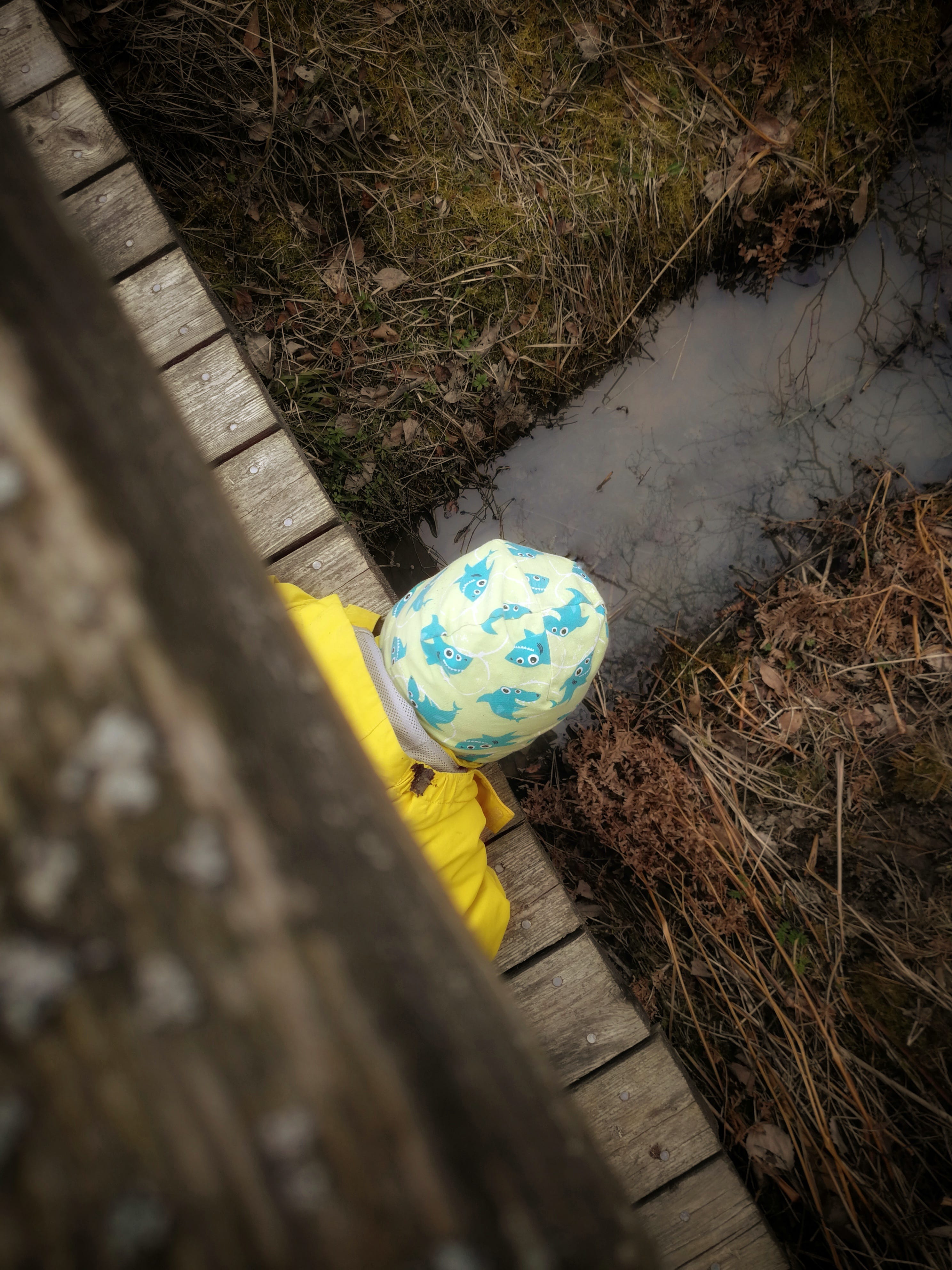
Now that my good friend lives in the same area, her child (5) naturally attends the same nursery that my own child, now already 10, once went to. The nursery is a cluster of small old wooden houses by the river, sheltered by old spruce trees. My friend’s child is, like me, a nature person: notices the smallest details in nature, is enchanted, curious. So I sent her, our little friend, a short video of a mandarin duck (mandariinisorsa in Finnish) I had seen recently in my nearby city of Turku, thinking that as a lover of nature and all things beautiful, she would surely be delighted.
And delighted she was – and in her video reply, she arranged for herself to come and visit us, as soon as possible, of course. My good friend and I are both inclined towards introversion, and we have always marvelled at our children, who are direct, brave and active also in their social interactions. The children, both only children, have through our close friendship become like siblings to one another.
So, at the initiative of our little friend – which was, of course, received with joy on our part – we went one Monday to pick her up from the familiar nursery along the familiar gravel road. It was one of the warmest days of the spring. I did not even have a coat on, and my child, who sweats even in frost, was wearing a T-shirt. As we walked, we reminisced about those years – gilded by memory, of course – all the times we had travelled this road back and forth, sometimes by bicycle, sometimes on foot, sometimes with the dog, sometimes with a sledge or a snowracer (rattikelkka). Nostalgic, my child said, and I no longer bother wondering where he has gathered all these words into his vocabulary. Do you remember when I sledged into a tree and found that white marble in the forest? And do you remember when I did that ninja jump into the ditch over there?
I remember. And I never want to forget – not those times, nor us within them.

Our little friend walked a long way holding my hand. It felt touching; I cannot remember when my own child last chose to do that. I had put fruit sweets into two small boxes, one pink and one green, and gave them to the children halfway along the path. We planned the afternoon’s activities, and it began to sound very much as though we had crammed too many wonderful things into one short afternoon, but I did not say that aloud. We’ll see, I said. I remember how irritating it was as a child when adults said we’ll see. Surely they know whether there’s time or not – why do we have to see? Just as irritating was when adults went out “to run errands”. Why couldn’t they simply say where they were going?
When we reached our letterbox – an old metal box that still bears the previous resident’s name even after 15 years – we took a look inside. No post, but look! A small spider was hanging from the lid, quickly pulling itself back to the inside on a safety thread. We all leaned in to watch the little spider. When I tried to move it from the inside of the lid with a stick, our little friend asked what I was doing. I said I was trying to move it to a better place, so it would not be crushed when I closed the lid. But surely it does not matter much if one spider dies, she said. Well, I said. In the grand scheme of things it may not matter much, but if one has committed to living in a way that cherishes all life, then even the life of a little spider is of value. Yes, she said, and clearly fell into thought.
As a parent, I feel I am something of a hippie in the sense that I do not want to shape life for my child according to what I think is right or wrong. I do not want to tell, I do not want to point. Instead, I want to be able to live my own life according to my values in every situation, to make my choices based on what I believe to be good and right. The child will see it, will know me as a person who lives like this, and instead of being told explicitly what is right and desirable, he can draw his own conclusions and make his own choices.

We eat chips and build a den. All of my child’s soft toy rabbits (how many are there, really!) go in for a bath, and we eat more fruit sweets. We feed sausage to our elderly dog, because the children find it amusing, and I think an old dog should have treats every day (which reminds me that our local shop has Ben & Jerry’s ice cream on offer, and I must remember to go and get a batch – for the dog, of course). We go to look for chocolate eggs at the edge of the garden and the forest, even though Easter has long since passed. We track the Easter Bunny by its droppings (it must be quite a large bunny, as its droppings look remarkably like horse chestnuts [hevoskastanja]). We pack a backpack and head out into the forest. Our little friend’s mother asks when she is coming home (we manage to negotiate a bit more time).
I do not always remember to be grateful for the beautiful nature that surrounds our little wooden house. Yet for years it has been a true lifeline, and especially when my own child was younger, there was nothing better than being able to step straight into the forest from the yard. Mushrooms, polypores, blueberries and insects always received us without prejudice. And we them. For many years, one of the most anticipated moments of spring was our first encounter with a dung beetle (metsäsittiäinen), which my child and I waited for so eagerly that I eventually ended up writing a series of three children’s books about beetles.
The children made their way into the forest, my older child neatly keeping to the path, our little friend climbing along rough terrain wherever it was most difficult. We stopped to look at a hollow dug into the moss (perhaps by a fox), the sunlight flickering through the trees, small mushrooms growing on a stump. What are they? our little friend asked. I said I was not sure, but they might be golden trumpets (kantonapanahikas), and began to look it up on my phone. Our little friend moved on, found a piece of plastic litter and picked it up to take to the park bin, and said something along the lines of what a funny name, and that perhaps it does not matter all that much what the mushroom is called – it can be that kind of mushroom if we like, or it can be something else.
I fell into thought.
Yes. Perhaps it does not matter all that much. They can be golden trumpets, or they can be something else. We humans have a strong need to name and classify things. That has its place, of course, but sometimes one could simply look at the sweet little mushrooms on a stump, admire them, acknowledge their existence in this world just as they acknowledge ours, without knowing our names, accepting us as we are.

In the park, the children swung and climbed and dug. We ate cinnamon roll biscuits and drank pear juice, and then it was time to walk the short distance to my good friend’s home, to take our little friend back.
My child and I walked home through the forest. We felt light, filled with nostalgia. The sun setting behind the spruce branches coloured everything in rose gold, and I did not want to be anywhere else.
Thank you for reading!
Nest regards,
Janina

You might also enjoy:
Of Nest Boxes and New Beginnings

You are reading Nest Regards, a publication about small wonders in nature, seen through the eyes of a middle-aged humanist studying biology and environmental science.